Abstract
Results
DROID
Fixed exterior camera · robot arm with parallel gripper
RoboCasa-GR1
Egocentric moving camera · humanoid with dexterous hands
The rendered interface gives the video model direct pixel-space evidence of robot motion, so predicted scene changes are better localized around the robot and the contact region than vector- or pose-conditioned baselines. Rendered robot geometry localizes robot-driven scene changes, while depth helps resolve contact-relevant proximity and occlusion.
Action Controllability
Holding the initial scene fixed and editing only the rendered nominal motion changes the predicted scene response — the model uses rendered robot geometry as the action signal.
The edited trajectory is redirected toward a different object in the same scene.
The edited trajectory is re-solved to approach from higher above the object.
Zero-Shot Embodiment Generalization
Since an action enters only as rendered robot geometry, robots never seen during training — a new arm–hand pairing, or even multiple arms — pass through the exact same interface and still drive a plausible scene response. This is nontrivial for vector- or pose-conditioned models, where a new embodiment brings a different action space and a new action-to-motion mapping to learn. Each clip shows Mesh rendering (input) · Ours (generated) · GT.
Beyond the rendered mesh shown here, the model also conditions on scene depth and end-effector depth; both are omitted from these strips for space.
An xArm 6 arm paired with an Inspire F1 hand — a combination never seen together in training. Evaluated on HRDexDB.
Two robot arms composed into a single scene — a robot count outside the single-arm training setup. Evaluated on DexMimicGen.
Application: Human Demonstration → Robot Video
Method Overview
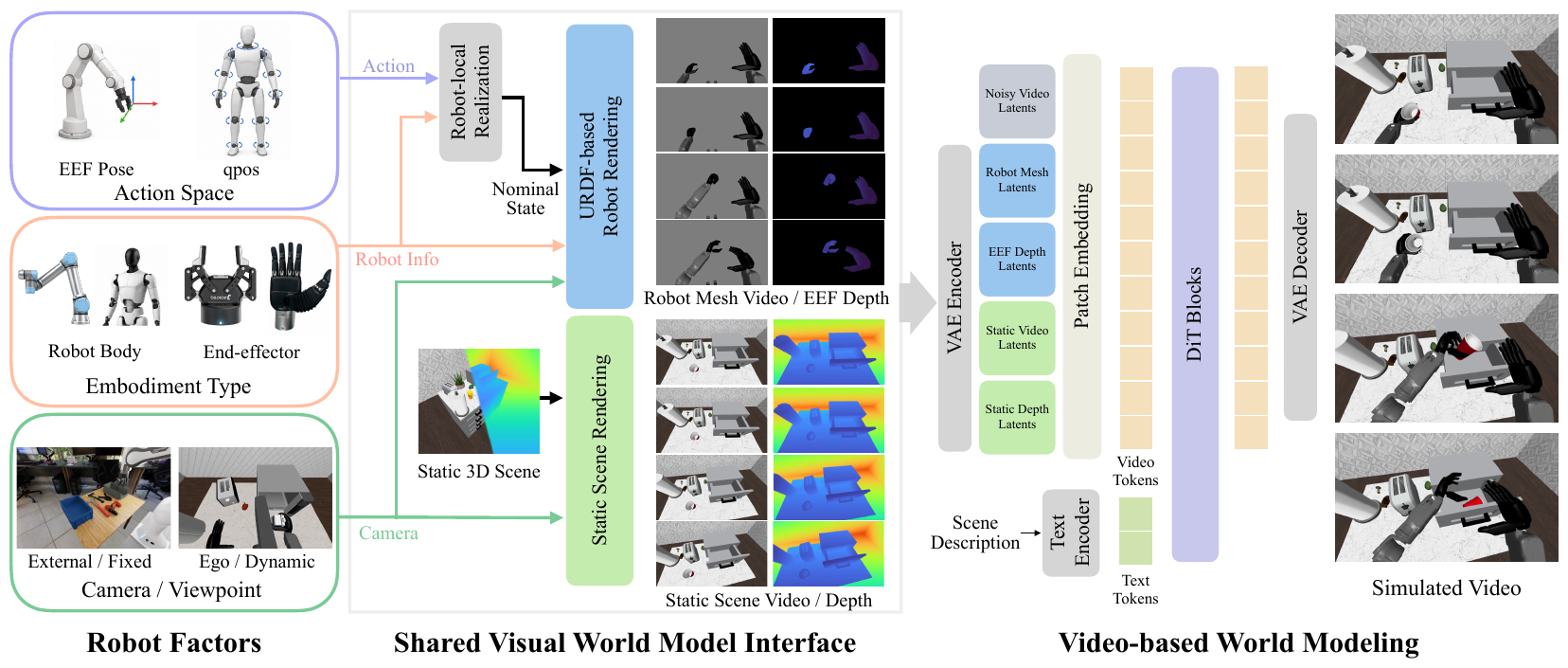
Instead of conditioning the world model on raw action commands, we factor out two robot-specific steps as fixed preprocessing. First, each action is rolled through the robot’s own controller and kinematics into a nominal trajectory — robot-only motion before any scene interaction. Second, this trajectory is rendered through the robot URDF into camera-aligned robot mesh RGB and end-effector depth. Paired with a camera-aware static stream (scene appearance and depth), these become the model’s entire action interface, leaving it the single shared problem of predicting how the scene responds.
Nominal Trajectory Conditioning
The right action signal lives between the raw command and the logged state: the controller-realized nominal trajectory is available at deployment and does not leak scene interaction.
DROID — the same episode rendered from each of the three signals.
A raw action is a command, not a motion. It has not yet passed through the controller, so it reflects neither the controller's tracking behavior nor the robot's kinematic and actuation limits — and it therefore departs substantially from the state the robot actually reaches.
The realized state is recorded in every dataset, but it is unavailable at inference: it is precisely the future the world model is asked to predict. Conditioning on it leaks the interaction outcome, since contact, compliance, and latency are already baked into the logged state.
RoboCasa-GR1 — nominal trajectory and realized state on a contact-rich rollout.
The two coincide while the robot moves freely, and separate once it meets the scene, where contact and compliance pull the realized motion away from the nominal plan. That divergence is not noise in the conditioning signal — it is the interaction itself, and predicting it is exactly what we leave to the world model.
Impact of Depth Conditioning
RGB mesh rendering places the robot only in the image plane, where overlap alone cannot tell a real touch from a robot simply passing in front of or behind an object. We pair end-effector depth with scene depth to make the model depth-aware, avoiding false contact from image-plane overlap.
BibTeX
@article{kim2026rofacto,
  title   = {Robot-Factored World Models via Robot Rendering},
  author  = {Kim, Byungjun and Kim, Taeksoo and Cha, Hyunsoo and Joo, Hanbyul},
  journal = {arXiv preprint arXiv:2607.22535},
  year    = {2026}
}